Compare and Despair
On Envy, Creative Careers, and Running Your Own Race


HOLLIE:
Last week in our Friday Favorites, I shared an essay called There I Almost Am: on Envy and Twinship by Jean Garnett from the Yale Review. The essay explores envy through the lens of twinship, prompting me to consider how universal envy is for anyone pursuing a creative career.
Garnett shares Francis Bacon’s description of envy, “the vilest affection, and the most depraved.” Which is true. Envy often makes us feel embarrassed and ashamed. It’s an emotion we’re not supposed to have.
I’ve always thought of myself as a good person, or at least someone who actively tries to be one, which is why I was so shocked by how often envy crept in when I first started working in Hollywood. It wasn’t that I thought other people didn’t deserve their success (most of them anyway), it was the question that wormed its way into my brain when I saw someone get a big break.
Why them and not me?
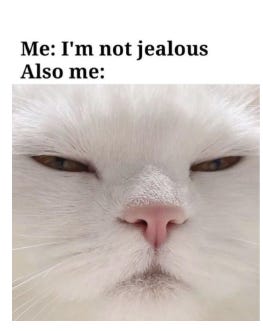
The hardest part about being a writer is that, more often than not, someone else appears to be doing better than you are.
Maybe you’re staffed on a television show, but someone else’s show is winning Emmys. Maybe you’ve published a novel, but someone else is winning literary prizes. Maybe you sold a movie, but someone else’s actually gets made.
In this business, there’s always a new level in the game, which means the level you’re at never feels like enough. But there came a point where I just didn’t want to live a life where I couldn’t be happy for others, or where I couldn’t embrace my own success.
I’ve had two experiences that permanently changed the way I think about envy. The first was in 2020 at the height of COVID.
I’d been writing professionally for more than a decade. I’d published three novels, but I‘d also been dropped by my UK publisher. Now, months into the pandemic, I was three months pregnant with triplets. I’d just gone through the emotional whiplash of selling and then un-selling a television show (a story for another day).
Then I landed an interview for a Netflix series.
Normally, I prepare obsessively for meetings, but this time I was battling relentless nausea and constant migraines. I couldn’t medicate because I was pregnant. Not to mention the anxiety of wondering what life with three babies would actually look like. My heart wasn’t fully in it, even though I desperately wanted the validation that came with getting the job.
A few days later, I learned that one of my closest friends had been interviewed, too. It sounds ridiculous, but when I learned she got the job, I cried. Not because I wasn’t happy for her, but I was sad for myself.
Here’s the thing. She’s a really good friend. She was one of the few people in our COVID pod. Shortly after she got the job, we escaped to Palm Springs together for a staycation while she was preparing to start the room. She had absolutely no idea how I felt, and likely won’t until she reads that.
It’s amazing how quickly envy morphs into self-loathing, which is like the ugly stepsister to envy. Being jealous of strangers isn’t admirable, but it’s understandable. Being jealous of your friends? Gross!
So I forced myself to write down everything I was grateful for and everything I wanted. I wrote down exactly what I wanted my own career life to look like. No comparing.
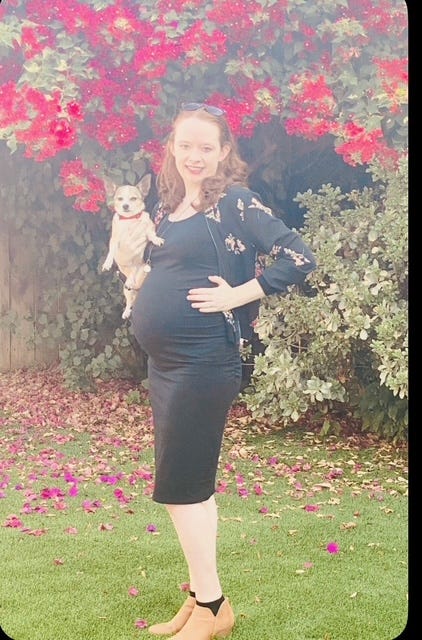
Heather also kept reminding me of my reality (sometimes less gently than I would have liked, but that’s sisters for ya.) “Hollie, you’re having triplets. You can barely stay awake and take two to three-hour naps a day. How are you going to be in a writer’s room?”
It was annoying, but true. I would have struggled. Eventually, I realized something important: It wasn’t my time to staff a television show. My job was to grow three babies and prepare for a new version of my life.
My second lesson in overcoming envy came from my friend, the brilliant novelist, Clarissa Goenawan.
We first met through The Bath Novel Award when we were both shortlisted for the prize. Shortly after, I was offered a contract for Baby Doll and had to withdraw because the rules prohibited published authors. Clarissa went on to win with her beautiful debut novel, Rainbirds.
Back when Twitter was still a relatively pleasant place to be, we’d message daily. I watched Clarissa fight to get her book out into the world. Despite winning a prestigious competition, she struggled to find representation and a publisher (Rainbirds is a beautiful book, but not the noisy kind that gets traditional publishers’ attention). She queried nonstop and refused to give up. Eventually, her persistence won out. She sold her book and published it in multiple countries, even going on to publish two more novels.
One day, after we’d both been published, I sent her a publishing announcement about another author who’d landed a massive two-book deal. “Must be nice,” I joked.
She replied with three words that have stayed with me ever since. “Compare and despair.”
Shockingly, I’d never heard the phrase before. Now I think about it all the time.
Hollywood and publishing are fueled by comparison. Who’s getting the overall deal? Who’s making the biggest sale? Whose staffing is on the hottest show? Who’s on the bestseller list? These days, it’s who’s working at all?
If you’re measuring your career against everyone else’s, it’s impossible not to feel like you’re unworthy. But these days, whenever I see a Deadline announcement or read publishing news that sparks that familiar twinge of envy, I let myself feel it for a moment.
Then I say “Compare and despair,” and I move on.
Because I’ve also learned something else. Years ago, before my daughters were born, my husband, David, and I were invited to a party hosted by my friend, another television writer. One of his neighbors was someone I’d worked with more than a decade earlier. As we caught up, he smiled and said, “You have the best career.”
I laughed. From where I was standing, my career felt messy. I started writing books because I couldn’t get staffed. I bounced between television and publishing because neither industry offered stability. It felt like years of uncertainty followed by brief moments of success.
The truth is, we don’t see what’s happening behind the scenes in someone else’s career. We see someone’s book deal, but not the hundred rejections. We see the TV staffing announcement, not the years between jobs. We see the published book, but not the poor sales or dropped contracts.
Thankfully, I’ve stopped trying to win someone else’s race. Why? Because my race has been pretty great. It’s included wins and losses; television rooms, four published novels, canceled projects, an odds-defying pregnancy, surviving three toddlers, breakthroughs, heartbreaks, and opportunities I never could have predicted.
None of it happened in the order I would have chosen, but it’s made me the writer I’m meant to be, and it’s allowed me to focus on what matters most: my stories.
Have you battled the green-eyed monster? How did you defeat it? Any strategies that keep you from falling into a pit of despair?
Let us know in the comments!
Crazy! This dropped in my inbox just moments after talking to my therapist at length about jealousy. Thanks for the reminder that this affliction comes for all of us!
I've come to really appreciate jealousy and look at it like breadcrumbs. Every time I'm jealous, it points me more deeply into the direction I want to go. My ego may not necessarily be onboard for the ride - but jealousy is usually a pretty good barometer of true desire.